





The Role of Fluke Angle in Anchor Penetration Efficiency
An anchor’s ability to hold a vessel in position depends on more than its weight and overall dimensions. Its geometry also plays an important role, particularly the angle of its flukes.
For fluke-style anchors, the fluke angle influences how the anchor interacts with the seabed, penetrates the sediment, and develops resistance against horizontal pulling forces.
An anchor that cannot penetrate the seabed properly may fail to establish its intended holding capacity. Even when the anchor is manufactured from strong materials, unsuitable geometry or an inappropriate working angle can reduce its effectiveness.
For marine equipment manufacturers, naval architects, boatbuilders, and procurement professionals, understanding the relationship between fluke angle and penetration efficiency is important when evaluating anchor designs.
This article explains what anchor fluke angle means, how it affects penetration, why seabed conditions matter, and what buyers should consider when specifying fluke-style marine anchors.
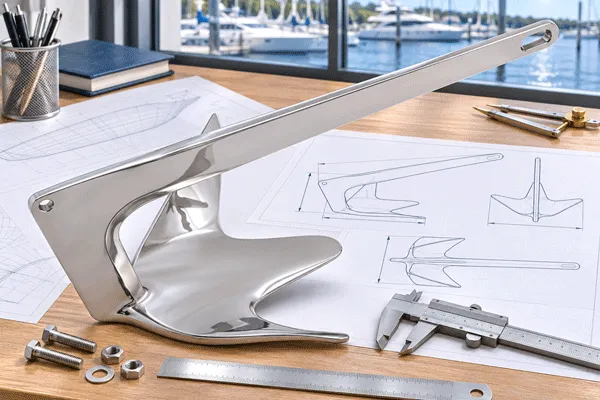
The Role of Fluke Angle in Anchor Penetration Efficiency
1. What Is an Anchor Fluke Angle?
The fluke angle is a geometric parameter describing the orientation of an anchor’s fluke relative to its shank or the manufacturer’s specified design reference.
The flukes are the working surfaces that penetrate the seabed and develop resistance when the anchor is pulled.
In a fluke-style anchor, the relationship between the flukes and the shank influences how the anchor enters the sediment under tension.
When the anchor is deployed, several components work together:
- Shank: Connects the anchor to the chain or rope and transfers the applied pulling force.
- Flukes: Penetrate the seabed and develop resistance against movement.
- Crown: Connects the shank and flukes and contributes to the anchor’s setting geometry.
- Stock or stabilizing components: Depending on the design, help control the anchor’s orientation during deployment and setting.
The fluke angle is not an isolated specification. It works together with the fluke shape, surface area, tip geometry, crown structure, and overall anchor proportions.
When evaluating technical drawings, buyers should confirm how the manufacturer defines and measures the angle, because design references and measurement conventions may differ between anchor models.
2. How Fluke Angle Influences Anchor Penetration
The primary function of a fluke is to penetrate the seabed and establish an embedded position.
When an anchor is deployed and tension is applied through its rode, the flukes interact with the bottom material.
The fluke angle influences this process in several ways.
2.1 Initial Contact with the Seabed
When the anchor reaches the seabed, its orientation determines how the flukes make initial contact with the bottom.
A suitable anchor geometry helps the working surfaces enter the sediment rather than simply slide across it.
The crown, shank connection, and any stabilizing components also influence whether the anchor reaches an appropriate setting position.
2.2 Fluke Penetration
As horizontal tension develops, the flukes begin to move through the sediment.
The angle influences the direction of the applied force relative to the working surfaces.
If the geometry is suitable for the seabed, the flukes can penetrate progressively and establish an embedded position.
If the angle is unsuitable, the anchor may penetrate only slightly or fail to establish a stable set.
2.3 Embedment Depth
Embedment depth describes how far the anchor penetrates into the seabed.
It is an important factor in determining the resistance developed by the anchor.
The relationship between fluke angle and embedment depth depends on the anchor design and soil characteristics.
A suitable angle helps the anchor develop the penetration needed for its intended holding performance.
2.4 Holding Resistance
Once the anchor is properly embedded, the surrounding sediment provides resistance against movement.
The effective holding performance depends on the interaction between the embedded flukes and the seabed.
The anchor must also remain stable under the applied load. Rotation, breakout, or an unsuitable pulling direction can reduce its holding resistance.
This is why fluke angle should be considered as part of the complete anchor design rather than as an independent performance guarantee.
3. Why Seabed Conditions Affect the Required Fluke Angle
One of the most important considerations in fluke angle design is the type of seabed where the anchor will operate.
Mud, sand, and harder bottom materials have different physical characteristics. As a result, an angle that works well in one environment may not provide the same penetration behavior in another.
3.1 Fluke Angle for Soft Mud and Silt
Soft mud and silt are relatively cohesive or weak sediment materials, depending on their composition and water content.
These conditions can require a different fluke geometry from firmer sand.
In many drag-embedment anchor designs, a larger fluke angle may help the anchor develop appropriate penetration in very soft sediment.
However, the correct angle depends on the anchor’s complete geometry and the actual properties of the seabed.
An excessively large angle can also prevent an anchor from setting properly.
Therefore, the selection should be based on the manufacturer’s design specifications and the intended soil conditions.
3.2 Fluke Angle for Sand Bottoms
Sand is a common seabed material for fluke-style anchors.
Its density, grain characteristics, and compaction influence how the flukes penetrate and how much resistance develops around the embedded anchor.
For firm or compact sand, many anchor designs use a smaller fluke angle than their specialized very-soft-mud configuration.
This allows the flukes to establish an appropriate penetration path without simply pushing against the surface.
The actual working angle should always be evaluated against the anchor model and manufacturer recommendations.
3.3 Fluke Angle for Harder Seabeds
Harder seabeds, including compact sand and stiff clay, can create additional penetration challenges.
If the fluke angle is unsuitable, the anchor may slide, fail to penetrate sufficiently, or become unstable during setting.
In some drag-embedment designs, reducing the fluke angle can improve penetration behavior in firmer bottom materials.
However, solid rock presents a different problem. Adjusting the fluke angle cannot make a conventional fluke anchor penetrate solid rock.
Anchor type and seabed suitability must therefore be considered together.
4. Understanding the Relationship Between Fluke Angle and Holding Power
A suitable fluke angle helps an anchor achieve the penetration and stability needed to develop its intended holding performance.
However, the relationship is not simply that a larger or smaller angle always produces better holding.
For each anchor design and seabed type, there is an effective working angle.
An angle that is too large may prevent adequate penetration and cause the anchor to slide or remain in a shallow position.
An angle that is too small may also reduce the embedment depth and prevent the anchor from developing its potential holding resistance.
Technical guidance in the U.S. Navy Salvage Manual explains that the optimum fluke angle varies with the anchor and soil type.
As a general reference for many drag-embedment anchor applications, it describes approximately 50 degrees for soft bottoms such as mud, soft clay, and silt, while firm sand and stiff clay may require angles in the range of approximately 25–35 degrees.
These figures are engineering references, not universal settings for every recreational or commercial anchor. Actual requirements must follow the specific anchor design and manufacturer’s technical data.
Fixed-Angle and Adjustable-Angle Designs
Some anchors are manufactured with a fixed fluke angle.
Others are designed with more than one approved angle position to accommodate different seabed conditions.
For example, certain adjustable anchor models offer a standard angle and a larger angle specifically for extremely soft mud.
This does not mean every fluke anchor can or should be adjusted.
Changing the angle without an approved design and assembly procedure may affect the anchor’s setting behavior and structural integrity.
Buyers should therefore confirm whether the selected anchor has a fixed or adjustable configuration before specifying it.
5. Other Design Factors That Influence Penetration Efficiency
Although fluke angle is important, it should not be evaluated separately from other structural and manufacturing characteristics.
Several design factors influence how an anchor enters and holds within the seabed.
5.1 Fluke Shape and Surface Area
Fluke shape determines how the working surface interacts with the bottom material.
The effective area of the flukes also influences how resistance is distributed through the surrounding sediment.
Their dimensions should be designed together with the intended angle and anchor proportions.
5.2 Fluke Tip Geometry
The leading edges and tips are the first parts of the anchor to interact with the seabed.
Their shape and condition influence the anchor’s ability to initiate penetration.
Poorly finished or damaged tips may affect setting behavior.
5.3 Crown and Stabilizing Structure
The crown helps connect the working components and influences the anchor’s setting position.
Depending on the anchor design, stabilizers or tripping components can help the anchor orient itself and begin penetrating.
These components must be compatible with the intended fluke geometry.
5.4 Shank and Connection Design
The shank transfers the pulling force from the anchor rode to the working structure.
Its dimensions, connection geometry, and structural strength should be appropriate for the intended application.
A well-designed fluke angle cannot compensate for an unsuitable shank or weak connection.
5.5 Manufacturing Accuracy
Manufacturing quality is important for maintaining the intended geometry.
Dimensional deviations between the flukes, crown, and shank can affect the assembled anchor configuration.
Depending on the product construction, relevant manufacturing processes may include casting, machining, welding, forming, and polishing.
For OEM marine anchor projects, approved drawings and inspection requirements should define the important dimensions and tolerances.
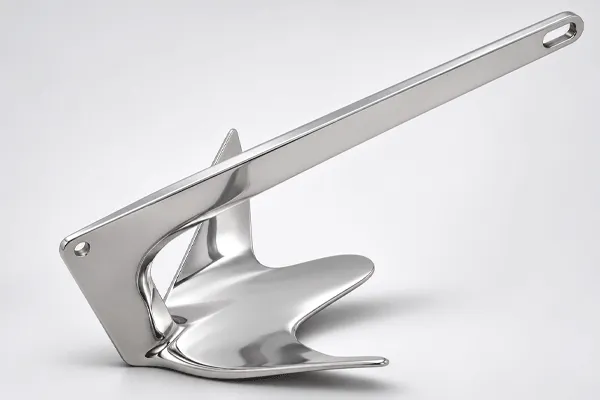
The Role of Fluke Angle in Anchor Penetration Efficiency
6. How to Evaluate Fluke Angle When Specifying Marine Anchors
For naval architects, boatbuilders, and marine equipment procurement teams, evaluating fluke angle should be part of the anchor specification process.
The following steps provide a practical framework.
Step 1: Identify the Intended Seabed
Determine whether the anchor is expected to operate mainly in sand, mud, silt, or harder bottom conditions.
The soil characteristics provide the starting point for evaluating the required geometry.
Step 2: Confirm the Anchor Design
Identify the anchor type and review its fluke arrangement, crown structure, and shank connection.
Different designs may use different working-angle requirements.
Step 3: Review the Manufacturer’s Angle Specification
Confirm the stated fluke angle, measurement reference, and whether the configuration is fixed or adjustable.
Do not assume that two anchors with similar external shapes use identical angle specifications.
Step 4: Review Performance Information
Ask the manufacturer for available technical data, test conditions, and information about the intended seabed application.
Holding-performance figures should always be interpreted in the context of the test method and soil conditions.
Step 5: Check Manufacturing and Assembly Quality
Review the dimensional drawings, material requirements, connection details, and inspection procedures.
The finished anchor should conform to the approved design.
Step 6: Evaluate the Complete Anchoring Arrangement
The anchor works together with the chain, rope, shackles, and vessel attachment.
The pulling direction and rode configuration also influence how effectively the anchor can penetrate and maintain its position.
A properly specified anchor is the result of coordinated design, manufacturing, and application assessment.
7. What Marine Hardware Buyers Should Ask Anchor Manufacturers
When purchasing anchors for boatbuilding, distribution, or OEM projects, buyers should request sufficient technical information to evaluate the product.
Useful questions include:
- What is the specified fluke angle?
- How is the fluke angle measured on the technical drawing?
- Is the angle fixed or adjustable?
- Which seabed conditions is the design intended for?
- Are different fluke configurations available?
- What are the fluke dimensions and thickness?
- What material and manufacturing processes are used?
- What dimensional inspections are performed?
- Is technical documentation available for repeat orders?
For customized anchor projects, buyers should also provide drawings, reference samples, material preferences, and intended application details.
This helps the manufacturer evaluate design feasibility and maintain consistency during production.
Conclusion
Fluke angle is an important design parameter in anchor penetration efficiency.
It influences how the flukes interact with the seabed, how deeply the anchor embeds itself, and how effectively the surrounding sediment resists movement.
However, no single angle is suitable for every anchor and every seabed. Soft mud, firm sand, and harder bottom conditions can require different design considerations.
The most effective anchor specification combines fluke angle with fluke geometry, shank and crown structure, material selection, manufacturing accuracy, and actual operating requirements.
For marine equipment manufacturers, boatbuilders, and OEM buyers, understanding these relationships helps improve product evaluation and technical communication during anchor sourcing.
Shenghui specializes in stainless steel marine hardware manufacturing and OEM/ODM customization. If you are developing customized marine anchors or related hardware, contact the team to discuss your drawings, dimensions, material requirements, and production specifications.
Contact Shenghui to discuss your marine hardware project.
FAQ
What is the fluke angle of an anchor?
The fluke angle is a geometric parameter describing the orientation of an anchor's flukes relative to its shank or specified design reference. It influences how the flukes penetrate and interact with the seabed.
Why is fluke angle important for anchor holding power?
Fluke angle affects penetration, embedment depth, and the way the anchor develops resistance within the seabed. An unsuitable angle may prevent the anchor from setting properly or reduce its effective holding performance.
Is a larger fluke angle always better for soft seabeds?
Not necessarily. Some anchor designs use larger angles for very soft mud or silt, but the optimum angle depends on the anchor's geometry and soil properties. An excessively large angle may prevent proper setting.
What fluke angle is suitable for sand bottoms?
There is no universal angle for every sand-bottom anchor. Many designs use a smaller angle than their specialized very-soft-mud configuration. Buyers should follow the manufacturer's specifications for the particular anchor model.
Can the fluke angle of a Danforth anchor be adjusted?
Some models are designed with approved adjustable positions, while others have fixed geometry. Buyers should check the manufacturer's assembly instructions and must not modify an anchor unless the design explicitly allows it.
Does fluke angle alone determine anchor holding capacity?
No. Holding capacity also depends on fluke area, anchor geometry, seabed properties, penetration depth, shank stability, deployment conditions, and the direction of the applied load.
What should buyers check when sourcing customized fluke anchors?
Buyers should confirm the fluke angle, measurement reference, fluke dimensions, material, structural connections, manufacturing tolerances, intended seabed conditions, and available performance documentation.