




Why Galvanized Steel Anchors Corrode in Saltwater: Causes, Prevention and Maintenance
Galvanized steel anchors are widely used in recreational boats, fishing vessels and other marine applications because they combine the mechanical strength of steel with the corrosion protection provided by a zinc coating. However, prolonged exposure to seawater, salt deposits and changing marine conditions can gradually damage this protective layer.
Once the zinc coating becomes depleted or damaged, the underlying steel becomes increasingly vulnerable to corrosion. If corrosion continues without proper inspection and maintenance, it can reduce the anchor’s effective cross-section, weaken critical structural areas and eventually affect its reliability during anchoring operations.
Why Galvanized Steel Anchors Corrode in Saltwater: Causes, Prevention and Maintenance
For boat manufacturers, yacht builders, marine hardware distributors and vessel operators, understanding how galvanized steel anchors deteriorate in saltwater is important when selecting products and planning maintenance.
This guide explains the corrosion mechanism of galvanized steel anchors, the environmental factors that accelerate deterioration, practical prevention methods and the conditions under which replacement should be considered.
1. How Does Saltwater Affect Galvanized Steel Anchors?
Galvanized steel is produced by applying a protective zinc coating to a steel substrate. Hot-dip galvanizing is a widely used process in which steel components are immersed in molten zinc to create a metallurgically bonded protective layer.
The zinc coating protects the underlying steel through two main mechanisms.
1.1 Barrier Protection
The zinc coating acts as a physical barrier between the steel substrate and the surrounding environment.
As long as the coating remains sufficiently continuous, it reduces direct contact between the steel and corrosive substances such as water, oxygen and dissolved salts.
The effectiveness of this barrier depends on coating thickness, coverage, surface condition and exposure conditions.
1.2 Sacrificial Protection
Zinc is more electrochemically active than steel. When the coating is locally damaged and both metals are exposed to an electrolyte, zinc can preferentially corrode and provide sacrificial protection to the exposed steel.
This mechanism helps protect small damaged areas rather than allowing the steel to corrode immediately.
However, sacrificial protection is not unlimited. As the zinc coating is gradually consumed, its ability to protect the steel decreases.
1.3 Why Seawater Accelerates Corrosion
Seawater contains dissolved salts, particularly chloride ions, which increase its electrical conductivity and contribute to aggressive corrosion conditions.
Several environmental factors can accelerate coating deterioration:
- Chloride exposure: Saltwater promotes electrochemical corrosion processes and can accelerate zinc consumption.
- Continuous immersion: Long-term exposure keeps the coating in contact with an electrolyte.
- Wet-and-dry cycles: Repeated immersion and drying can leave concentrated salt deposits on the anchor surface.
- Mechanical abrasion: Contact with seabeds, rocks, chains and anchor-handling equipment can damage the protective coating.
- Temperature and oxygen conditions: Environmental changes can influence corrosion rates and the formation of corrosion products.
The actual corrosion rate varies according to coating condition, seawater characteristics, anchor usage and maintenance practices.
2. Common Signs of Corrosion on Galvanized Steel Anchors
Identifying early corrosion is important because surface deterioration can develop into more serious structural damage if left unaddressed.
Not all discoloration indicates immediate structural failure. Buyers and vessel operators should understand the differences between common corrosion symptoms.
2.1 White Rust on the Zinc Coating
White rust is commonly associated with the corrosion of zinc.
It may appear as a white or gray powdery deposit on galvanized surfaces, particularly when moisture remains trapped between closely packed components or when newly galvanized products are stored under unsuitable conditions.
White corrosion products do not automatically mean that the steel substrate has been significantly damaged. However, extensive deposits may indicate deterioration of the protective coating and should be inspected.
2.2 Red Rust on Exposed Steel
Red or reddish-brown rust is generally a sign that the underlying steel has begun to corrode.
This can occur when the zinc coating has been consumed, scratched, chipped or otherwise damaged.
Red rust around anchor flukes, the shank, crown, welds or connection areas deserves particular attention because these locations may experience mechanical contact and repeated loading.
2.3 Coating Damage and Localized Corrosion
Mechanical damage can expose small areas of steel to seawater.
Common causes include:
- Repeated contact with rocks and hard seabeds.
- Abrasion against anchor chains and connecting hardware.
- Impact during deployment and retrieval.
- Improper handling or storage.
- Damage caused by unsuitable cleaning or repair methods.
Localized corrosion may initially appear minor, but continued exposure can gradually increase the affected area.
2.4 Pitting and Section Loss
More advanced corrosion can produce localized pits and reduce the thickness of the steel substrate.
This is particularly concerning in load-bearing areas, where material loss may affect the anchor’s structural integrity.
Visible corrosion should therefore be evaluated together with the component’s dimensions, remaining material thickness and structural condition.
3. Why Do Galvanized Steel Anchors Deteriorate Faster in Some Marine Environments?
Two galvanized anchors with similar designs may experience different service lives depending on how and where they are used.
The following factors are especially important when evaluating corrosion risk.
3.1 Continuous Seawater Exposure
Anchors that remain immersed for extended periods experience more continuous contact with seawater.
This can gradually consume the zinc coating, particularly when the coating is relatively thin or has already sustained mechanical damage.
The actual service life depends on the coating specification, water conditions and anchor construction.
3.2 Abrasion During Anchoring Operations
An anchor is repeatedly exposed to mechanical contact during normal use.
When it is deployed, its flukes and crown may contact sand, gravel, rocks or other seabed materials.
During retrieval, the anchor may also contact the bow roller, chain and deck equipment.
These interactions can wear away the zinc coating over time, creating exposed areas that become vulnerable to corrosion.
3.3 Crevices and Difficult-to-Clean Areas
Certain anchor geometries contain narrow gaps, joints and overlapping surfaces where moisture and salt deposits may accumulate.
If these areas are not properly cleaned and dried, localized corrosion can become more difficult to detect.
For manufacturers, coating coverage and surface preparation are important considerations when producing galvanized marine anchors.
3.4 Improper Storage
Storing a wet anchor in an enclosed or poorly ventilated space can prolong moisture exposure.
Salt deposits may remain on the surface, while trapped moisture can contribute to corrosion.
Proper rinsing, drainage and ventilation help reduce unnecessary deterioration.
3.5 Contact with Dissimilar Metals
When different metals are electrically connected in the presence of an electrolyte, galvanic corrosion may occur.
The rate and location of corrosion depend on the metals involved, their relative exposed areas, electrical continuity and environmental conditions.
For marine equipment buyers, compatibility between the anchor, chain, shackles and other connecting hardware should be considered during system design.
Why Galvanized Steel Anchors Corrode in Saltwater: Causes, Prevention and Maintenance
4. How to Prevent Corrosion on Galvanized Steel Anchors
Although galvanized steel anchors require maintenance in marine environments, several practical measures can help preserve the protective coating and extend their useful service life.
4.1 Rinse with Freshwater After Use
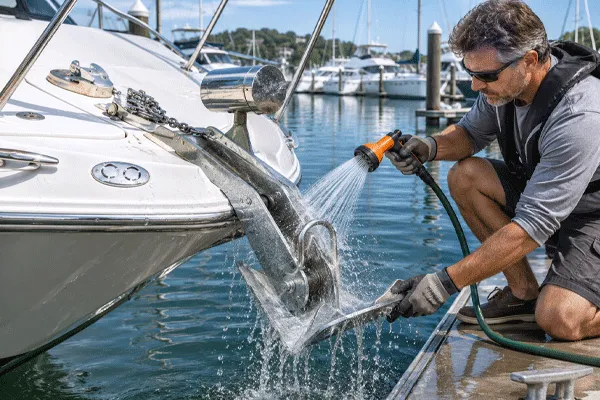
Rinsing the anchor with freshwater after saltwater exposure helps remove accumulated salt deposits.
Pay particular attention to the flukes, crown, shank, connection points and other areas where seawater or sediment may remain.
This is a simple maintenance practice that helps reduce prolonged salt exposure.
4.2 Inspect the Zinc Coating Regularly
Regular visual inspection helps identify coating damage before it develops into more extensive corrosion.
Check for:
- White or gray zinc corrosion products.
- Red rust indicating exposed steel.
- Scratches and coating loss.
- Localized pitting.
- Cracks or deformation.
- Corrosion around joints and connection points.
Inspection frequency should reflect the anchor’s operating environment and usage.
Anchors exposed to frequent deployment, abrasive seabeds or continuous immersion may require more frequent checks.
4.3 Store the Anchor in a Dry, Ventilated Area
When an anchor is not in use, allow it to drain and dry properly before storage.
Avoid leaving wet anchors in enclosed spaces where moisture can remain trapped.
Suitable storage arrangements can help limit unnecessary corrosion during periods of inactivity.
4.4 Repair Damaged Galvanized Coatings Properly
Small areas of coating damage may sometimes be repaired using an appropriate zinc-rich repair system.
The repair process should follow the coating manufacturer’s instructions and relevant galvanizing repair requirements.
Important considerations include:
- Removing loose corrosion products and contaminants.
- Preparing the damaged surface correctly.
- Using a compatible zinc-rich repair material.
- Applying the specified coating thickness.
- Allowing the repaired area to cure properly.
Marine paint or epoxy coatings may also provide additional barrier protection when properly selected and applied.
However, simply painting over rust or applying an incompatible coating will not restore the original galvanizing protection.
4.5 Avoid Unnecessary Mechanical Damage
Careful handling can help reduce coating wear.
Avoid dragging anchors over abrasive surfaces unnecessarily, striking them against hard objects or using unsuitable tools during cleaning.
Where possible, ensure that the anchor is properly aligned with the bow roller and compatible with the vessel’s handling equipment.
4.6 Evaluate Sacrificial Anodes Carefully
Sacrificial anodes are widely used in marine corrosion-control systems, particularly for submerged metallic structures and vessel components.
They work by providing preferential electrochemical protection to electrically connected metal surfaces.
However, attaching an anode to an individual galvanized anchor is not a universal corrosion-prevention solution.
Effective cathodic protection requires appropriate material selection, electrical continuity, suitable positioning and an assessment of the entire system.
For ordinary removable anchors, freshwater rinsing, coating inspection and appropriate storage are often more practical maintenance measures.
5. When Should You Replace a Corroded Galvanized Steel Anchor?
Surface rust does not always mean that an anchor must be replaced immediately. However, structural corrosion should never be ignored.
The decision to continue using, repair or replace an anchor should depend on the extent of corrosion and the condition of its load-bearing components.
5.1 When Surface Repair May Be Appropriate
Minor coating damage may be suitable for repair when:
- The underlying steel remains structurally sound.
- There is no significant material loss.
- The anchor has no cracks or permanent deformation.
- The damaged area can be properly cleaned and recoated.
- The repair is compatible with the original coating system.
If the damage is located in a critical structural area, professional evaluation may still be necessary.
5.2 When Replacement Should Be Considered
Replacement is generally the safer option when an anchor shows:
- Deep or widespread pitting corrosion.
- Significant reduction in material thickness.
- Cracks or structural deformation.
- Severe corrosion around welded or load-bearing connections.
- Damaged connection points that compromise secure attachment.
- Evidence of structural failure or uncertain remaining strength.
A heavily corroded anchor should not be returned to service simply because its exterior has been repainted.
For professional vessel operators and marine equipment buyers, replacement decisions should be based on structural condition and applicable equipment requirements rather than appearance alone.
6. Galvanized Steel vs. Stainless Steel Anchors: Which Is More Suitable for Saltwater?
Material selection is an important part of anchor specification.
Galvanized steel and stainless steel offer different combinations of mechanical properties, corrosion behavior, appearance and maintenance requirements.
| Comparison | Galvanized Steel Anchors | Stainless Steel Anchors |
|---|---|---|
| Corrosion protection | Zinc coating | Chromium-rich passive surface film |
| Protection mechanism | Barrier and sacrificial protection | Passive corrosion-resistant surface |
| Surface condition | Coating may wear or be consumed | Surface can be affected by chloride exposure |
| Maintenance | Coating inspection and freshwater rinsing | Cleaning and corrosion inspection |
| Appearance | Typically galvanized finish | Can offer polished or brushed finishes |
| Main considerations | Coating quality and remaining zinc layer | Alloy grade, surface condition and exposure |
Galvanized Steel Anchors
Hot-dip galvanized steel anchors provide a protective zinc layer over a steel structure.
They are suitable for many marine anchoring applications when the coating specification, product design and operating environment are properly considered.
Their long-term corrosion performance depends on the condition and remaining thickness of the zinc coating.
Stainless Steel Anchors
Stainless steel relies on a chromium-rich passive film that helps resist corrosion.
316 stainless steel is widely used for marine hardware because it generally offers better resistance to chloride-related corrosion than 304 stainless steel.
However, stainless steel is not completely immune to corrosion in seawater.
Crevice corrosion, pitting and surface contamination can still occur under certain conditions, particularly in stagnant or aggressive marine environments.
For high-end yacht and leisure marine applications, stainless steel anchors can offer an attractive combination of appearance, corrosion resistance and manufacturing flexibility.
The appropriate material should be selected according to the vessel’s operating environment, anchor design, maintenance expectations and purchasing requirements.
7. What Should Buyers Check When Sourcing Galvanized Steel Anchors?
For importers, distributors, yacht builders and marine equipment suppliers, evaluating a galvanized anchor requires more than checking its shape and weight.
The following factors can help buyers assess product suitability and manufacturing consistency.
7.1 Galvanizing Process and Coating Specification
Confirm whether the anchor uses hot-dip galvanizing or another surface treatment.
For hot-dip galvanized products, buyers should review the applicable coating specification, thickness requirements and inspection criteria.
Coating consistency and coverage are particularly important around edges, joints and complex geometries.
7.2 Anchor Structure and Manufacturing Quality
The anchor’s structural design should be suitable for its intended application.
Important inspection points include:
- Fluke geometry and dimensions.
- Shank and crown construction.
- Weld quality where applicable.
- Connection and fastening details.
- Dimensional consistency.
- Surface condition and coating coverage.
These factors influence product quality and suitability for the intended anchoring arrangement.
7.3 Material and Quality Documentation
Professional buyers should request relevant material and manufacturing documentation.
Depending on the product specification, this may include material information, galvanizing records, dimensional inspection results and applicable mechanical test documentation.
Documentation should match the actual product and agreed purchasing requirements.
7.4 Supplier Manufacturing and Customization Capabilities
For distributors and marine equipment brands, a supplier’s ability to maintain consistent production quality is important.
Buyers should evaluate manufacturing experience, production processes, inspection procedures, customization support and communication capabilities.
For OEM and ODM projects, technical drawings, samples and clear product specifications help manufacturers assess feasibility and establish consistent production requirements.
8. Shenghui’s Stainless Steel Marine Hardware Manufacturing Capabilities
Shenghui focuses on stainless steel marine hardware manufacturing, supplying products for yacht builders, boat manufacturers, marine equipment distributors and international OEM/ODM customers.
Our product range covers stainless steel anchors, marine mooring hardware, deck fittings, Bimini top fittings and other marine accessories.
We combine investment casting, precision CNC machining and surface finishing to produce marine hardware with attention to structural details, dimensional accuracy and product appearance.
For customized projects, our team can discuss product dimensions, material requirements, surface finishes and other specifications based on customer drawings, samples or technical requirements.
Whether buyers are evaluating anchor products, sourcing stainless steel deck hardware or developing customized marine fittings, selecting a manufacturer with suitable production and quality-control capabilities is an important part of the procurement process.
Conclusion
Galvanized steel anchors can provide reliable service in many marine applications, but their corrosion resistance depends on the condition of the zinc coating and the environment in which they operate.
Understanding the causes of coating deterioration, identifying early corrosion symptoms and following suitable maintenance practices can help extend anchor service life and reduce unexpected replacement costs.
For professional marine equipment buyers, selecting the right anchor also requires attention to structural design, galvanizing quality, dimensional accuracy and manufacturing consistency.
Shenghui specializes in stainless steel anchors and marine hardware, combining investment casting, precision CNC machining and OEM/ODM customization to support the sourcing requirements of international marine industry customers.
Contact our team to discuss stainless steel anchor products, customized marine hardware and your project specifications.
FAQ
Why do galvanized steel anchors rust in saltwater?
Saltwater contains chloride ions that create an aggressive corrosion environment. Over time, the zinc coating on a galvanized anchor is gradually consumed. If the coating is damaged or depleted, the underlying steel becomes exposed and can develop red rust.
How long does a galvanized steel anchor last in seawater?
There is no universal service-life figure. It depends on zinc coating thickness, coating quality, seawater conditions, immersion time, mechanical abrasion and maintenance practices. Regular inspection is necessary to assess the remaining protective coating.
Is white rust on a galvanized anchor dangerous?
White rust is generally associated with corrosion of the zinc coating. It does not automatically indicate structural failure, but extensive deposits may signal coating deterioration. The affected area should be inspected for exposed steel and more serious corrosion.
Can galvanized steel anchors be repaired after rusting?
Minor coating damage may be repaired using suitable zinc-rich repair systems after proper surface preparation. However, anchors with deep pitting, significant material loss, cracks or deformation should be evaluated for replacement.
Is stainless steel better than galvanized steel for boat anchors?
Neither material is universally better for every application. Stainless steel offers a corrosion-resistant passive surface and an attractive finish, while galvanized steel uses a protective zinc coating. The appropriate choice depends on operating conditions, product design, maintenance requirements and budget.
Can I paint over a galvanized steel anchor to prevent corrosion?
A compatible marine coating system can provide additional barrier protection when properly prepared and applied. However, paint should not be applied directly over loose rust, salt deposits or unsuitable surfaces. Damaged galvanized areas require appropriate preparation and repair.
Does a sacrificial anode protect a galvanized steel anchor?
A sacrificial anode can protect electrically connected submerged metal components when the cathodic protection system is properly designed. It is not a universal solution for individual removable anchors and should not replace coating maintenance and inspection.