





How Danforth Anchors Hold in Mud, Sand, and Rocky Bottoms
Choosing the right marine anchor involves more than comparing anchor weight or dimensions. The seabed beneath a vessel has a direct influence on how effectively an anchor can penetrate, develop holding resistance, and maintain its position under changing loads.
Danforth anchors, also known as fluke anchors, are widely recognized for their lightweight construction and high holding-power-to-weight ratio. Their distinctive two-fluke design allows them to penetrate suitable seabed materials and bury themselves under tension. However, their performance can vary considerably between firm sand, soft mud, and rocky seabeds.
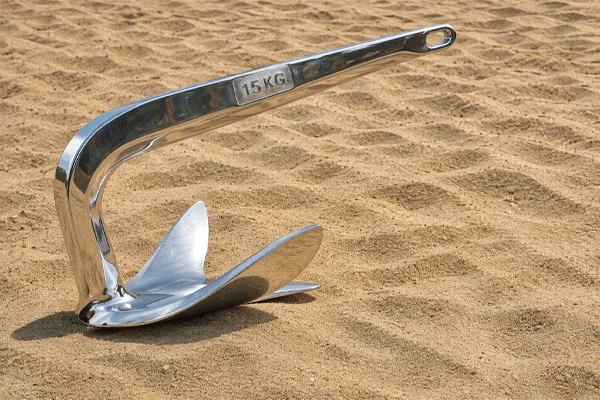
How Danforth Anchors Hold in Mud, Sand, and Rocky Bottoms
For boat owners, marine equipment distributors, shipbuilders, and professional buyers, understanding these differences is essential when selecting anchoring equipment.
This guide explains how Danforth anchors work, why seabed composition matters, what affects anchor holding capacity, and which factors should be evaluated before choosing an anchor for a particular vessel or marine application.
1. Understanding the Working Principle of Danforth Anchors
A Danforth anchor is a lightweight fluke-style anchor characterized by two broad, pivoting flukes connected to a central shank. A transverse stock near the crown helps the anchor orient itself as it contacts the seabed.
Unlike traditional heavy anchors that rely substantially on their mass and shape, Danforth anchors develop much of their holding capacity through penetration into the seabed.
Their working principle involves several stages.
Initial Contact with the Seabed
When deployed, the anchor reaches the bottom and rests on its flukes and stock. Its orientation and the condition of the seabed influence how effectively it can begin setting.
Fluke Penetration
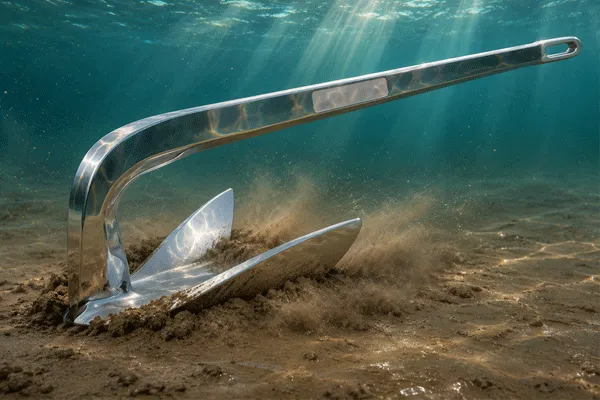
As tension is gradually applied through the anchor rode, the flukes rotate and begin digging into the bottom material. Their pointed edges help penetrate suitable sediment.
Burial and Resistance Development
As the anchor moves deeper into the seabed, the surrounding soil creates resistance against movement. The embedded fluke surfaces interact with the sediment, allowing the anchor to resist horizontal pulling forces.
Holding Under Load
Once properly set, the anchor relies on the resistance developed within the seabed to maintain the vessel’s position.
This explains why a relatively lightweight Danforth anchor can provide substantial holding capacity in suitable conditions.
However, successful setting is essential. An anchor that rests on the bottom without properly penetrating it cannot deliver its expected holding performance.
2. How Danforth Anchors Perform in Different Seabed Conditions
The composition and mechanical characteristics of the seabed are among the most important factors affecting anchor performance.
Different bottom materials offer different levels of penetration resistance, soil strength, and mechanical engagement.
2.1 Danforth Anchors in Mud Bottoms
Mud is a common seabed material in harbors, sheltered bays, estuaries, and other coastal environments.
Danforth anchors can perform effectively in suitable muddy conditions because their broad flukes provide a relatively large surface area for developing resistance within the sediment.
However, not all mud bottoms behave in the same way.
Firm or Compacted Mud
Firm mud can provide a suitable environment for fluke penetration and burial.
When the anchor enters the sediment properly, the surrounding material can generate resistance against horizontal movement. The broad flukes help distribute the applied load over a larger embedded area.
Very Soft or Loose Mud
Extremely soft mud presents a different challenge.
The sediment may have insufficient shear strength to resist the applied load effectively. Loose mud can also accumulate around the flukes, interfering with proper penetration and setting.
In these conditions, the anchor may drag before developing sufficient holding resistance.
Mud Over a Harder Substrate
Some seabeds contain relatively thin mud layers above sand, clay, or other materials.
The depth and characteristics of the sediment layer can influence how deeply the flukes penetrate and how much resistance the anchor develops.
For buyers evaluating Danforth anchors for muddy environments, fluke area, geometry, penetration capability, and the actual seabed profile should all be considered.
2.2 Danforth Anchors in Sand Bottoms
Sand is generally one of the most favorable seabed materials for conventional Danforth-style anchors.
The pointed flukes can penetrate the sediment and become buried under the pull of the anchor rode.
Once embedded, the surrounding sand provides resistance against the anchor’s movement.
Several factors influence performance:
- Sand density: Firm, compact sand generally provides favorable penetration and holding conditions.
- Particle characteristics: Different sand compositions can produce different penetration and resistance behavior.
- Fluke geometry: The dimensions and working angle of the flukes influence how the anchor enters and engages the sediment.
- Setting technique: The anchor must be pulled in a way that allows its flukes to penetrate rather than simply slide across the surface.
In suitable sand conditions, Danforth anchors can provide strong holding performance relative to their weight.
This is one reason they remain a popular choice for vessels operating in sandy coastal and inland waters.
2.3 Danforth Anchors on Rocky Bottoms
Rocky seabeds present a significant challenge for Danforth anchors.
The fundamental difference is that Danforth anchors are designed to penetrate sediment, while solid rock generally does not allow their flukes to bury in the same way.
When deployed over rocks, the flukes may:
- Slide across hard surfaces without penetrating.
- Catch temporarily on rock edges or irregularities.
- Become trapped between rocks or other underwater structures.
- Fail to establish a consistent holding position when the pulling direction changes.
A particularly important issue is false setting.
An anchor may appear secure because one of its flukes has caught on a rock or underwater obstruction. However, this does not necessarily mean the anchor has established reliable holding resistance.
When wind, current, or vessel movement increases the load, the anchor may suddenly release.
For rocky seabeds, alternative anchor designs may be more appropriate.
Depending on the seabed structure and vessel requirements, buyers may evaluate:
- Fisherman’s or hook-style anchors.
- Grapnel anchors.
- Plow-style anchors.
- Claw-style anchors.
Each design has different operating characteristics. The final choice should account for the actual seabed, vessel type, expected loading, and retrieval requirements.
It is also important to avoid anchoring directly on sensitive coral or protected seabed habitats where prohibited.
3. Key Factors Affecting Danforth Anchor Holding Power
Although seabed conditions are fundamental, anchor performance is determined by the interaction of several factors.
3.1 Anchor Design and Fluke Area
The flukes are the primary working components of a Danforth anchor.
Their surface area, shape, thickness, penetration edges, and pivoting geometry influence how the anchor interacts with the seabed.
A larger effective fluke area can help distribute resistance across more embedded sediment. However, simply increasing the dimensions does not automatically guarantee better performance.
The anchor must also maintain suitable geometry and structural integrity under the expected loading conditions.
3.2 Vessel Size, Displacement, and Windage
Anchor selection should consider the vessel as a complete system rather than relying only on its length.
Important characteristics include:
- Overall vessel length.
- Loaded displacement.
- Hull shape.
- Above-water profile and windage.
- Expected operating environment.
Two vessels with similar lengths may experience significantly different environmental loads because of differences in displacement and exposed surface area.
A vessel with a large cabin or superstructure may experience greater wind loading than a lower-profile vessel of similar length.
3.3 Wind, Current, and Wave Conditions
Environmental conditions directly affect the forces acting on an anchored vessel.
Wind creates horizontal loading on exposed surfaces, while current produces additional forces on the hull and underwater structures.
Waves and vessel movement can introduce dynamic loading, increasing the demands placed on the anchor and rode.
Anchor selection should therefore account for the expected operating environment rather than relying exclusively on calm-weather requirements.
3.4 Water Depth and Anchor Rode
Water depth is another important consideration, although it does not directly determine the required anchor weight.
It affects the amount of anchor rode needed to establish an appropriate scope.
Scope refers to the ratio between the deployed rode length and the vertical distance from the vessel’s bow attachment point to the seabed.
Adequate scope helps maintain a relatively low pulling angle at the anchor.
A steep pulling angle can reduce the anchor’s ability to remain embedded, increasing the likelihood of dragging.
A suitable combination of rope, chain, shackles, and anchor connections is therefore essential.
Chain weight also helps maintain a lower pulling angle and protects the rope from abrasion against the seabed.
4. How to Select the Correct Danforth Anchor Weight
One of the most common mistakes in anchor selection is assuming that a heavier anchor will always provide better holding performance.
Anchor weight matters, but holding capacity also depends on anchor design, seabed penetration, vessel loading, and anchoring technique.
A practical selection process should consider the following factors.
Step 1: Evaluate Vessel Specifications
Determine the vessel’s length, displacement, loading condition, and windage.
Use these details to identify an appropriate anchor size range.
Step 2: Identify the Seabed Composition
Establish whether the vessel will normally anchor in firm sand, compact mud, loose mud, rock, or mixed seabed conditions.
A Danforth anchor should not automatically be selected for every environment.
Step 3: Assess Environmental Conditions
Consider the expected wind speed, current, waves, tidal changes, and exposure of the anchorage.
More demanding conditions may require different anchor specifications and a more comprehensive anchoring arrangement.
Step 4: Review Anchor Manufacturer Recommendations
Consult the manufacturer’s sizing chart for the specific anchor model.
Different anchor designs can produce different holding performance even when their weights are similar.
Step 5: Evaluate the Complete Anchoring System
The anchor should work together with the rode, chain, shackles, bow attachment, and vessel configuration.
The entire system must be suitable for the intended operating conditions.
There is no single universal formula that can accurately determine Danforth anchor weight for every vessel and seabed.
For commercial supply boats, workboats, and other professional vessels, anchor selection should be reviewed against actual operating requirements and applicable engineering or classification guidance.
5. Practical Considerations for Setting a Danforth Anchor
Correct deployment is just as important as choosing an appropriate anchor.
Even a well-designed anchor can fail to develop its intended holding capacity if it is improperly positioned or deployed.
Check the Anchorage Before Deployment
Review nautical charts, depth information, local anchoring guidance, and available seabed information.
Avoid locations where the anchor may interfere with underwater infrastructure, navigation channels, or protected habitats.
Approach with Control
Approach the intended anchoring position with consideration for wind and current.
Lower the anchor in a controlled manner rather than throwing it into the water, which can increase the risk of tangling or improper orientation.
Allow the Flukes to Set
Pay out an appropriate length of rode and apply controlled tension.
The anchor should be allowed to penetrate the seabed rather than being dragged across its surface at an uncontrolled angle.
Verify the Holding Position
Once the anchor has been deployed, apply a gradual setting load in accordance with the vessel’s operating procedure.
Check the vessel’s position against fixed landmarks or navigation equipment to identify possible dragging.
A temporary catch on a rock or obstruction should not be mistaken for a reliable set.
Monitor Conditions During Anchoring
Wind direction, current, and tidal conditions can change after deployment.
The vessel’s position should be monitored throughout the anchoring period, particularly in exposed locations or changing weather.
How Danforth Anchors Hold in Mud, Sand, and Rocky Bottoms
6. What Should Marine Equipment Buyers Consider When Sourcing Anchors?
For marine equipment distributors, boatbuilders, importers, and OEM buyers, evaluating an anchor involves more than comparing product photographs and listed weights.
A reliable sourcing process should include several technical and manufacturing considerations.
Material Selection
Material selection should match the intended marine environment and product requirements.
Stainless steel grades such as 304 and 316L may be considered for different marine hardware applications. Buyers should confirm the material specification and suitability for the intended exposure conditions.
Corrosion resistance alone does not determine an anchor’s holding capacity or structural suitability.
Dimensions and Structural Design
Important details include:
- Overall anchor length and width.
- Fluke dimensions and geometry.
- Shank dimensions.
- Pivot and connection structure.
- Anchor weight.
- Compatibility with chains and shackles.
These specifications should be evaluated together rather than individually.
Manufacturing Quality
Manufacturing processes influence dimensional consistency, surface condition, and structural quality.
Depending on the product design, buyers may need to evaluate casting, machining, welding, polishing, and other finishing processes.
Inspection procedures and material documentation are also important when establishing repeatable purchasing requirements.
OEM and ODM Customization
For marine brands and distributors developing their own product ranges, customization may involve dimensions, structural details, materials, surface finishing, and branding.
Before starting a custom project, buyers should provide technical drawings, reference samples, required dimensions, and intended application details.
A clearly defined specification helps manufacturers evaluate feasibility and maintain consistency between production batches.
7. Why Understanding Seabed Conditions Matters Before Choosing an Anchor
Danforth anchors offer a practical combination of relatively low weight, convenient storage, and strong holding performance in suitable sediment conditions.
However, their effectiveness is closely related to the seabed into which their flukes must penetrate.
Firm sand and suitable mud can provide favorable conditions for setting and developing resistance. Extremely soft mud may not provide enough support, while rocky bottoms can prevent proper penetration altogether.
For vessel operators and marine equipment buyers, the most effective approach is to evaluate the anchor, vessel, seabed, rode, and environmental conditions as one interconnected system.
A suitable anchor is not simply the heaviest available option. It is the anchor design and size that match the vessel’s actual operating requirements.
If you are sourcing stainless steel marine anchors or developing customized marine hardware, working with an experienced manufacturer can help ensure that material, dimensions, manufacturing processes, and product specifications are properly evaluated.
Shenghui provides stainless steel marine hardware manufacturing and OEM/ODM customization services. Buyers can explore the Anchor Series and discuss their project requirements with the team.
Contact Shenghui to discuss your marine hardware sourcing and customization requirements.
FAQ
Are Danforth anchors suitable for muddy seabeds?
Yes. Danforth anchors generally perform well in suitable firm or compact mud because their broad flukes can penetrate the sediment and develop holding resistance. However, extremely soft or loose mud may prevent reliable setting.
Do Danforth anchors work on rocky bottoms?
Danforth anchors are generally not recommended for rocky bottoms. Their flukes depend on penetrating the seabed, while solid rock prevents effective burial. They may temporarily catch on rock formations, but this does not guarantee reliable holding.
What seabed conditions are best for Danforth anchors?
Firm sand and suitable mud are generally favorable conditions. These materials allow the flukes to penetrate and bury themselves, creating resistance against horizontal movement.
Does a heavier Danforth anchor always provide better holding power?
No. Anchor weight is only one part of the selection process. Fluke geometry, seabed composition, vessel displacement, windage, rode scope, and deployment technique also influence holding performance.
How does anchor chain improve holding performance?
Anchor chain adds weight to the rode and helps maintain a lower pulling angle at the anchor. It can also reduce abrasion of the rope against the seabed and help manage loading within the anchoring system.
Can a Danforth anchor be used for commercial supply boats?
It depends on the vessel's size, displacement, operating environment, seabed conditions, and required anchoring performance. Commercial workboats and supply vessels should follow appropriate engineering assessments and manufacturer recommendations rather than relying on general recreational boat sizing charts.
What information should buyers provide when ordering customized marine anchors?
Buyers should provide the intended application, vessel specifications, anchor dimensions, preferred material, structural requirements, drawings or reference samples, surface finishing requirements, and expected operating environment. These details help manufacturers evaluate product feasibility and customization requirements.